


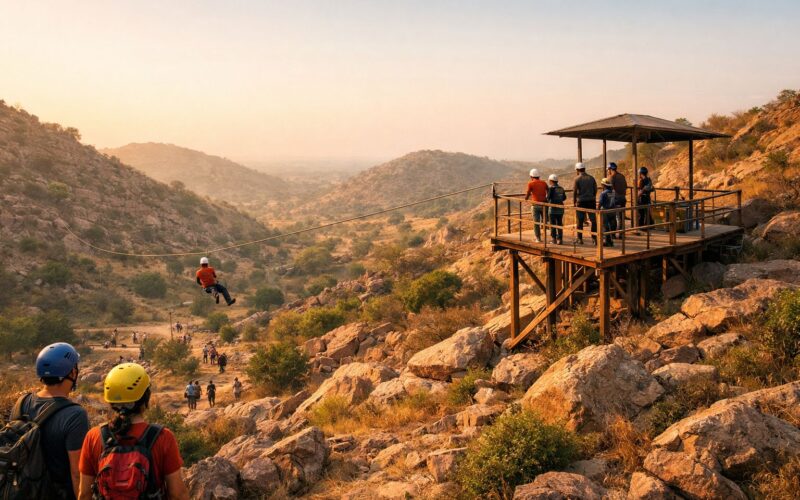


Why Aravalli Has Become Gurgaon’s 45-Minute Escape
Something has changed around Gurgaon over the last few seasons.
Weekend resorts still exist. Cafés are still full.
But a different kind of search has quietly increased:
“Adventure camp near Gurgaon.”
Scroll through social media on a Friday evening and you’ll notice it — rope courses, helmets, zipline clips, dusty ATV tracks, bonfire nights under rocky hills.
The shift isn’t accidental.
Urban weekends are becoming more active.
And almost all of that activity is flowing toward one terrain system — the Aravalli range.
The Geography Advantage No One Talks About
The Aravalli hills stretch along the Sohna and Manesar corridors, sitting within 30–60 minutes of major Gurgaon hubs like Cyber City and Golf Course Road.
That proximity is powerful.
You can leave office on Friday evening and be on a zipline platform before sunset.
You can run a half-day corporate offsite without losing hours in highway traffic.
You can take your family out Saturday afternoon and be back by Sunday morning.
Distance is no longer a barrier.
It’s a booking catalyst.
Terrain Changes the Experience


Not all adventure setups feel the same — even if they list similar activities.
Natural Aravalli slope terrain allows:
Rock climbing on uneven natural surfaces
Zipline descent along real elevation
ATV tracks across variable ground
Open-air obstacle installations
Flat-land activity farms can host rope courses too.
But slope-integrated camps create a very different sensation.
Climbing on real rock feels textured.
Ziplining across a ridge sustains momentum.
ATV rides on uneven terrain feel immersive.
You may see the same activity names on multiple listings.
But terrain execution defines memory value.
Why Professionals Are Choosing Camps Over Resorts
This isn’t just about thrill.
It reflects a broader behavioral shift.
Passive relaxation is slowly being replaced by structured participation.
Instead of buffet-heavy weekends, many Gurgaon professionals now prefer:
Team-based challenges
Short-duration adrenaline
Outdoor air
Guided activity blocks
Adventure camps are not competing with luxury hotels.
They are competing with inactivity.
And proximity gives Aravalli a natural edge.
The Rise of Corporate & Group Bookings
Search patterns around:
corporate outing near Gurgaon
team outing Sohna Road
adventure camp for office group
show consistent seasonal spikes.
Corporate teams prefer structured outdoor engagement because it:
Encourages participation
Breaks hierarchy barriers
Fits within half-day schedules
Keeps travel time minimal
Similarly, birthday groups and school trips find Aravalli convenient because supervision and activity density can be managed within a controlled environment.
But Here’s Where Confusion Begins
If you’ve already searched for camping in Aravalli, you’ve probably noticed something:
Most camps list similar activities.
Zipline
Rock climbing
ATV
Paintball
The real difference isn’t what is listed.
It’s how it’s executed.
And that’s where most booking uncertainty begins.
Some setups are temporary.
Some are slope-integrated.
Some bundle ATV.
Some charge separately.
Some rotate groups efficiently.
Some don’t.
This guide exists to decode that difference.
Day Camps vs Overnight Camping: What Actually Changes (And What Doesn’t)
If you’ve explored options around the Aravalli belt, you’ve probably seen two common formats:
Day Adventure Camp
Overnight Camping Experience
At first glance, the difference feels obvious — one includes stay, the other doesn’t.
But in reality, the distinction goes deeper than duration.
And most booking confusion starts right here.
The Day Adventure Camp Format (4–6 Hours of Structured Activity)

Day camps are built for efficiency.
They’re typically designed for:
Corporate half-day outings
School field trips
Birthday groups
High-energy friend meetups
The structure is simple:
You arrive.
You’re divided into rotation groups.
You move through activity blocks in scheduled slots.
You wrap up within a fixed window.
Activities usually include combinations of:
Zipline
Rock climbing
Rope obstacles
Team-building games
Sometimes ATV or paintball depending on the package
The appeal of a day format is clarity.
You know your time window.
You know your schedule.
You leave the same day.
For corporate planners especially, this predictability reduces logistical friction.
Where Day Camps Sometimes Disappoint
The most common assumption?
“That everything listed is fully included.”
In many Aravalli activity zones, premium elements like ATV rides or extended paintball sessions may be optional add-ons rather than default inclusions.
Also, the total number of guaranteed activity rounds can vary depending on:
Group size
Instructor ratio
Rotation efficiency
If you’re booking for a large group, asking how long one full rotation cycle takes can prevent last-minute frustration.
Day camps are energy-dense.
But they are time-compressed.
The Overnight Camping Format (Immersion Over Compression)

Now let’s talk about overnight formats.
When people search for overnight camping near Delhi NCR, they’re usually looking for something more immersive than a four-hour session.
Overnight experiences typically combine:
Structured adventure activities
Tent accommodation
Dinner and breakfast
Bonfire engagement
Morning tea routines
But the biggest difference isn’t the tent.
It’s pacing.
With an overnight format, activities don’t feel rushed.
Downtime becomes part of the experience.
Conversation continues after sunset.
Corporate teams often prefer this format when bonding matters more than efficiency.
Families appreciate it when they want a short escape without long travel hours.
Friend groups choose it for celebration dynamics.
The terrain remains the same.
The emotional outcome shifts.
What Actually Changes Between Day and Overnight?
Here’s the honest breakdown.
The infrastructure — zipline systems, climbing anchors, ATV tracks — generally does not change.
What changes is:
Time flexibility
Activity pacing
Meal inclusion
Night-time engagement
Morning experience
Day camps prioritize activity completion.
Overnight formats prioritize shared immersion.
Neither is inherently better.
They serve different objectives.
Pricing Structure Differences (Without the Confusion)
Regionally, the pattern usually looks like this:
Day format → Lower entry price
Overnight format → Higher per-person range
But pricing depends heavily on:
Activity bundling
Meal structure
Tent category
Group size
Season timing
Two listings may show similar numbers but include very different things.
That’s why inclusion clarity matters more than headline pricing.
Who Should Choose a Day Camp?
A day format makes sense if:
You want structured activity without overnight commitment.
Your group is budget-sensitive.
You’re organizing a corporate half-day session.
You prefer minimal travel fatigue.
It works well for tight schedules.
But it can feel rushed if bonding depth is your priority.
Who Should Choose Overnight Camping?
An overnight experience works best if:
You value shared downtime after activities.
You’re planning a celebration-style outing.
You want bonfire engagement.
You prefer relaxed pacing over time compression.
It allows decompression.
And decompression often defines memory.
The Subtle Psychological Difference
Here’s something most listings don’t explain.
Day camps are event-focused.
Overnight camps are experience-focused.
That single distinction can help you decide faster than any activity list.
If your goal is “Let’s do activities and wrap up,” choose day.
If your goal is “Let’s experience something together,” choose overnight.
Zipline, ATV, Rock Climbing & Paintball: What Really Varies Across Camps
By the time most people reach this stage, they’ve already compared multiple listings.
The activity names look similar everywhere:
Zipline
ATV
Rock climbing
Paintball
But here’s what usually causes confusion.
The name of the activity stays the same.
The execution changes completely.
And that difference often determines whether the experience feels average or memorable.
Let’s break this down clearly.
Zipline in Aravalli: Length, Slope & Flow Matter

Zipline is the most searched activity across the Sohna–Manesar corridor.
But “zipline available” tells you almost nothing.
What actually varies:
Line length (short 80–120m vs extended 250–300m)
Natural ridge-based descent vs artificial tower
Single-lane vs dual-lane system
Number of rounds included
A short flat-line zip feels quick and controlled.
A longer ridge-based descent along Aravalli slope creates sustained momentum and a panoramic outdoor sensation.
The psychological difference is significant.
Difficulty Level
Beginner-friendly. Minimal physical strength required.
Typical Age Range
Usually 7+ years (weight compliance matters more than age alone).
Smart Booking Question
“How many zipline rounds are guaranteed in the package?”
Many setups include one standard round. Additional rounds may be chargeable.
ATV Ride: The Most Misunderstood Activity

Search interest for ATV rides near Gurgaon remains consistently high.
But this is also where expectation mismatch happens most often.
What varies:
Track terrain (flat loop vs uneven slope track)
Ride duration (3-minute loop vs extended 8–10 minutes)
Bundled inclusion vs paid add-on
Some camps operate compact circular tracks primarily for beginner comfort.
Others integrate uneven natural ground for a more immersive ride.
Both are controlled.
But the feeling differs.
Difficulty Level
Beginner to Moderate. Briefing is mandatory before riding.
Typical Age Range
Usually 12+ years, depending on height and control comfort.
Smart Booking Question
“Is one ATV ride included, or is it charged separately?”
Clarify early to avoid last-minute confusion.
Rock Climbing & Rappelling: Natural Rock vs Artificial Wall
This is where terrain integration makes a visible difference.
Natural rock climbing on Aravalli slope introduces:
Uneven grip texture
Variable incline
Open landscape exposure
Artificial climbing walls provide:
Uniform holds
Predictable routes
Controlled vertical panels
Neither is unsafe when supervised.
But the sensory experience is different.
If immersion matters, slope-based climbing feels more authentic.
Difficulty Level
Beginner routes are commonly available. Advanced slopes are optional.
Typical Age Range
Usually 6+ with supervision.
Smart Booking Question
“Is the climbing surface natural rock or an artificial wall?”
Small detail. Big difference.
Paintball: Not Just About Shooting Pellets

Paintball is popular for corporate outings and friend groups.
But satisfaction depends on structure.
What varies:
Pellet limit per person
Private session vs mixed group
Field layout (flat open field vs terrain-based obstacle field)
Most basic packages include limited pellets. Additional ammunition often costs extra.
A terrain-based field with natural cover adds tactical depth compared to open-ground setups.
Difficulty Level
Low physical strain, moderate team intensity.
Typical Age Range
Usually 10–12+ depending on safety gear.
Smart Booking Question
“How many pellets are included per person?”
This prevents the most common complaint.
Activity Transparency vs Activity List
Here’s the bigger insight.
Most listings emphasize the number of activities.
But number alone doesn’t define experience quality.
Length of zipline.
Slope of climbing surface.
Rotation structure.
Add-on clarity.
Instructor supervision.
These details influence satisfaction more than the headline count.
You’ve probably seen multiple listings that look almost identical.
The difference is rarely in the name.
It’s in execution.
Quick Snapshot: Difficulty & Accessibility
Low Intensity
Zipline
Paintball
Moderate Engagement
ATV
Beginner climbing
Higher Engagement
Extended climbing routes
Long obstacle cycles
Most terrain-based camps are designed for beginner accessibility.
This is structured adventure — not extreme sports.
Why This Matters Before You Book
If you’re comparing options across the Aravalli belt, this is usually the stage where uncertainty peaks.
Not because the activities look confusing.
But because the details aren’t explained clearly.
When clarity increases, hesitation decreases.
And informed bookings almost always lead to better experiences.
Pricing Breakdown: What Influences Cost & Where Hidden Charges Appear
If you’ve searched for:
adventure camp near Gurgaon price
camping in Aravalli cost per person
overnight camping near Delhi NCR charges
You’ve probably noticed something.
Prices seem similar.
But details are not.
Two camps may show nearly identical rates — yet deliver very different experiences.
Let’s decode how pricing actually works across the Aravalli activity belt.
The Typical Regional Price Range
Across Sohna Road and Manesar corridors, the general structure looks like this:
Day Adventure Format:
₹1,200 – ₹2,000 per person
Overnight Camping Format:
₹2,500 – ₹4,000 per person
These are broad regional ranges.
What changes the final quote is inclusion structure — not just duration.
What Drives Day Camp Pricing?
Day format costs usually depend on five variables:
Activity bundling
ATV inclusion
Paintball pellet limit
Meal plan depth
Group size
A ₹1,500 plan might include zipline and rope course only.
A ₹1,800 plan might include climbing, lunch, and structured team games.
On paper, the price difference feels small.
In practice, the value difference can be noticeable.
The Add-On Layer Most People Miss
Here’s where booking friction often begins.
Premium elements are sometimes treated separately.
Common add-ons include:
ATV rides
Extra paintball pellets
Additional zipline rounds
Private instructor allocation
Extended obstacle access
These are not hidden in a deceptive sense.
They are operational choices.
The problem arises when they are not clarified during inquiry.
If a listing only says “ATV available,” always confirm:
Is one round included?
Or is it priced per ride?
That single question prevents most misunderstandings.
What Drives Overnight Camping Cost?
Overnight pricing is influenced by a different structure.
Tent category
Meal structure (veg buffet vs structured service)
Activity rotation limits
Bonfire setup
Sanitation infrastructure
Group size
For example:
Two overnight packages at ₹3,000 per person may differ in:
Tent comfort level
Activity access duration
Meal variety
Inclusion of ATV
The headline number doesn’t tell the full story.
Group Discounts & Negotiation Reality
Most terrain-based camps operate on group economics.
Common patterns include:
20+ participants → Per-person flexibility possible
40+ participants → Customized bundling discussions
Weekday bookings → Higher negotiation room
Peak winter Saturdays, however, often have limited flexibility due to demand pressure.
If you’re planning a large corporate outing, earlier inquiry usually improves price structure.
The Psychology of “Cheapest Option”
When comparing listings, price becomes the first filter.
But booking rarely happens at the lowest number.
It happens where clarity is strongest.
A slightly higher quote that clearly explains:
Activity rounds
Add-on costs
Rotation flow
Meal details
often feels safer than a cheaper but vague listing.
Clarity reduces decision fatigue.
Reduced fatigue increases conversion confidence.
A Simple Value Check Before You Confirm
Instead of asking:
“Which is the cheapest camp near Gurgaon?”
Ask:
How many guaranteed activity rounds are included?
Is ATV bundled?
What is the paintball pellet count?
Is lunch or dinner included?
Are tents standard or upgraded?
Five questions remove 90% of pricing confusion.
Safety, Age Limits & Supervision: What You Should Verify Before Booking
Adventure sounds intense.
Helmets. Harnesses. Ridges. ATV engines.
But most terrain-based camps in the Aravalli belt are designed for controlled thrill — not extreme sports.
Still, safety structure varies between operators.
And this is where informed booking matters most.
First: Understand the Nature of “Controlled Adventure”
Most Aravalli activity zones are built for:
Corporate teams
School groups
Families
Mixed-age participants
They are not mountaineering expeditions.
They are structured outdoor engagement formats.
The real safety difference rarely lies in the activity itself.
It lies in supervision depth and operational process.
Zipline Safety: What Actually Matters
A properly managed zipline setup includes:
Certified harness systems
Helmet enforcement
Instructor-assisted attachment
Platform stability checks
Weight compliance guidelines
Most systems operate within defined weight brackets. Age is secondary to harness fit.
A mechanically stable zipline is predictable.
Risk increases only when supervision becomes rushed.
That’s why instructor-to-group ratio matters.
ATV Ride Safety: Briefing Determines Outcome
ATV rides are controlled loops — not open desert runs.
Structured setups include:
Pre-ride control demonstration
Speed restriction briefing
Helmet enforcement
Track supervision
Most camps restrict ATV access to 12+ years depending on height and control capability.
If younger participants are involved, always confirm policy before booking.
The terrain may look rugged.
But controlled loops make the experience predictable.
Rock Climbing & Rappelling Safety
Climbing safety depends on:
Harness integrity
Top-rope anchor systems
Belay supervision
Helmet use
Natural rock adds authenticity — but requires proper anchor installation and rope inspection.
Well-managed camps operate with:
Fixed anchor points
Dedicated belay instructors
Single-participant descent control
Beginner routes are usually lower in height and less steep.
Advanced slopes are optional, not mandatory.
Paintball Safety: Structure Over Speed
Paintball injuries are rare when safety rules are enforced.
Structured sessions include:
Mandatory protective masks
Defined shooting distance rules
Instructor field monitoring
Pellet velocity regulation
Age restrictions usually fall between 10–12+ depending on gear fit.
The most common issue in paintball isn’t safety — it’s pellet limits.
Always confirm count per participant.
Age Limit Snapshot (General Regional Pattern)
While policies vary slightly between camps, common age guidelines across the Aravalli corridor are:
Zipline → 7+ (weight-based compliance)
Rock Climbing → 6+ supervised
Paintball → 10–12+
ATV → 12+
Age is often less important than height, harness fit, and instructor supervision.
Parents should confirm equipment compatibility for younger participants.
Instructor Ratio: The Silent Quality Indicator

This detail rarely appears in promotional pages.
But it strongly influences safety and experience flow.
Ask:
How many instructors manage a group of 30–40 participants?
Are activities supervised separately?
Are safety briefings conducted before each rotation?
Higher instructor allocation improves both:
Activity speed
Supervision quality
For corporate planners and school coordinators, this question matters more than activity count.
Infrastructure Permanence & Sanitation

Permanent setups typically offer:
Built washrooms
Fixed anchor systems
Defined briefing zones
Dedicated activity tracks
Temporary or seasonal installations may rely on:
Portable washrooms
Temporary anchors
Rotational staff
Both can operate safely.
But permanence often correlates with structured process consistency.
For family groups and corporate HR teams, this adds comfort.
What Usually Creates Post-Booking Discomfort?
Not accidents.
Expectation mismatch.
Examples include:
Assuming ATV was included
Underestimating waiting time
Not clarifying pellet limits
Ignoring sanitation details
All of these are preventable with clear pre-booking questions.
Perfect. Now we conclude the pillar properly.
This final part ties together:
• Terrain
• Activities
• Pricing
• Safety
• Decision clarity
• Structured positioning
Clean. Balanced. Not salesy.
Strong for SERP. Safe for Discover.
How to Choose the Right Camp + What a Structured Setup Looks Like
By now, you’ve seen:
How terrain changes experience.
How day and overnight formats differ.
How activity execution varies.
How pricing structures shift.
How supervision impacts safety.
So the real question becomes:
How do you actually choose?
Because at this point, most listings start to look similar.
A Simple 6-Point Decision Framework
Before confirming any booking in the Aravalli activity belt, verify these six factors.
1️⃣ Terrain Integration
Is the camp built on natural slope terrain or flat ground installations?
Natural ridge-based setups usually offer more immersive zipline and climbing experiences.
2️⃣ Inclusion Transparency
What is guaranteed?
Number of zipline rounds
ATV inclusion or add-on
Paintball pellet count
Meal structure
Clarity prevents dissatisfaction.
3️⃣ Instructor Structure
How many instructors manage your group size?
Higher instructor allocation improves both supervision and activity rotation speed.
4️⃣ Infrastructure Permanence
Are washrooms built and permanent?
Is the setup fixed or temporary?
Permanent infrastructure often signals operational maturity.
5️⃣ Group Rotation Planning
If you’re booking for 25+ participants, ask:
How long does one full activity cycle take?
Poor rotation planning creates waiting time — which affects satisfaction.
6️⃣ Experience Objective
Are you planning:
A fast-paced activity event?
Or a slower, immersive bonding experience?
Day camps prioritize energy.
Overnight formats prioritize shared memory.
Clarify your objective first. Everything else becomes easier.
What a Well-Structured Terrain-Based Setup Should Include
Across the Aravalli belt, several structured camps operate with slope-integrated layouts and fixed infrastructure.
A well-managed terrain-based setup typically offers:
Defined activity zones
Natural slope integration
Structured group rotation
Clear activity inclusion
Permanent sanitation facilities
Pre-activity safety briefings
Transparent pricing communication
When these elements align, booking confidence increases naturally.
A Reference Example: WildHawk Resort

Located along the Sohna corridor within the Aravalli ridge system, WildHawk Resort operates as a fixed, slope-integrated adventure and camping setup.
Its format reflects the structural elements discussed throughout this guide:
Natural terrain-backed zipline layout
Rock climbing integrated into real slope surface
Defined ATV track zones
Structured group rotation scheduling
Permanent washroom facilities
Clear separation between day and overnight formats
Day experiences focus on high-energy rotation blocks.
Overnight formats combine activity with bonfire engagement and slower pacing.
The terrain remains constant.
The experience format adapts.
Why Terrain-Based Camps Are Growing in Popularity
The rise of Aravalli adventure experiences isn’t accidental.
It aligns with:
Urban weekend compression
Corporate team-building demand
Short-distance travel preference
Activity-focused leisure trends
Within 30–60 minutes of Gurgaon, few outdoor zones offer both:
Natural terrain
Structured supervision
Flexible group formats
That combination creates repeat booking potential.
Final Thought: Clarity Beats Comparison
When comparing adventure camps near Gurgaon, most people focus on:
Price
Activity count
Distance
But long-term satisfaction usually depends on:
Terrain authenticity
Execution depth
Instructor structure
Infrastructure stability
Inclusion transparency
The activity names may be similar across listings.
Execution determines memory.
Quick Recap of This Complete Guide
You’ve now seen:
Why Aravalli has become Gurgaon’s active escape
How day and overnight formats differ
What really varies in zipline, ATV, climbing, and paintball
How pricing structures shift
What safety and supervision factors matter
How to evaluate a camp intelligently
This guide was designed to remove confusion — not increase it.
Because informed decisions reduce booking hesitation.
And clarity creates better experiences.
Frequently Asked Questions About Adventure Camps in Aravalli Near Gurgaon
The best option depends on what you’re prioritizing — terrain authenticity, inclusion clarity, instructor supervision, or overnight comfort. Instead of focusing only on activity count, compare natural slope integration, guaranteed activity rounds, ATV inclusion, and infrastructure permanence before booking.
Day adventure camps generally range between ₹1,200 to ₹2,000 per person, while overnight camping formats typically range from ₹2,500 to ₹4,000 per person. Pricing varies based on activity bundling, meal structure, tent type, and group size.
Not always. Some camps include one ATV round in the base package, while others treat it as an add-on. Always confirm whether ATV is bundled or charged separately before finalizing your booking.
Yes, most terrain-based camps are designed for beginners and supervised participation. Zipline and climbing operate with harness systems and instructor control. However, age limits usually apply — zipline (7+), climbing (6+), ATV (12+), and paintball (10–12+).
Most camps along the Sohna and Manesar corridor are located within 30–60 minutes from central Gurgaon, depending on traffic and exact location.
Day camps focus on structured activity rotation within 4–6 hours. Overnight camping includes tent stay, meals, bonfire, and slower pacing. The terrain remains the same — the experience duration changes.
Established camps usually provide permanent washroom facilities with proper plumbing. Temporary setups may use portable arrangements. If hygiene is a priority, verify sanitation infrastructure before booking.
Common activities include zipline, rock climbing, rappelling, rope obstacles, ATV rides, paintball, and team-building games. However, activity execution and inclusion limits vary across camps.
Resorts are suitable for passive relaxation. Adventure camps are better for structured participation and team engagement. Your choice depends on whether you prefer leisure or active outdoor experience.
October to March is considered peak season due to comfortable weather. However, weekday corporate bookings operate throughout the year.